














2020 DFM
book is now also KNOW as the
BOOK OF STANDARDS
for universal needs for
Design for strictness, innovation, &
optimizing everything
WHAT MAKES THIS THE BEST DFM BOOK EVER
This 600 page book adds what the publisher says
is already the definitive work on
product
development and now the Second Edition adds 100 new and unique pages
that
have never been published before, thus resulting in the following:
Thorough manufacturability can be complete
products in h
alf the budget with savings
ranging
from half to one-tenth in nine categories (3.8).
Research and early product development start with Manufacturable Research (3.9), that optimizes concept/architecture (3.3.9), assures part availability (3.9.7) and process availability, (3.9.10), achievable tolerances (3.9.8), and avoids work force challenges (4.8.4.2) on hard-to-build products (3.9.9), all of which can start providing immediate scalable, commercialization results. The design process emphasizes thorough up front work (Chapter 3) in complete multi-functional tams (Chapter 2) that cane quickly scale up production without limits, delays, or extra cost (4.8)) to avoid shortages by design by design.
Product development improvement champions and implementers will also benefit from Section 3.11 (and its 10 sub-sections) on generating interest in designing better products for manufacturability. All this can be applied right away on a project team (11.7) in its own micro-climate (3.11.6.1).
LEADING-EDGE BOOKS BY
DR. DAVID M ANDERSON, P.E., CMC, fASME
New 2020 book to be published June 2,
which can be pre-ordered now AT:
https://www.amazon.com/Design-Manufacturability-Concurrent-Engineering-High-Quality/dp/0367249944/ref=sr_1_2?dchild=1&keywords=MANUFACTURABILITY&qid=1589596590&s=books&sr=1-2-
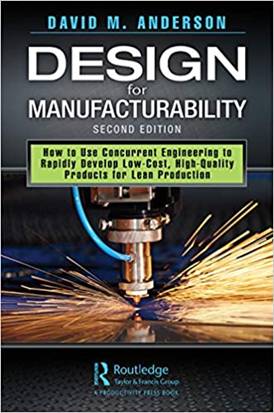 "Design for Manufacturability: How to Use Concurrent
Engineering to Rapidly Develop Low-Cost,
High-Quality Products for Lean Production," Second
Edition (690 pages,
Productivity Press)
"Design for Manufacturability: How to Use Concurrent
Engineering to Rapidly Develop Low-Cost,
High-Quality Products for Lean Production," Second
Edition (690 pages,
Productivity Press)
Design
for Manufacturability: How to Use Concurrent Engineering to Rapidly Develop
Low-Cost, High-Quality Products for Lean Production is
still the definitive work on DFM – this second edition extends the proven
methodology to the most advanced product development process with the addition
of the following new, unique, and original topics, which have never been
addressed previously. These topics show you how to:
·
Cut
cost from 1/2 to 1/10 in 9 categories -- with ways to remove that much cost from
product charges and pricing.
·
Commercialize
innovation -- starting with
Manufacturable Research and learning from the new section on scalability, you
will learn how to design products and processing equipment to scale quickly to
any growth levels.
·
Design
product families that can be built “on-demand” in platform cells that also
“mass customize” products to-order
·
Make
Lean production easier to implement with much more effective results while
making build-to-order practical with spontaneous supply chains and eliminating
forecasted inventory by including updated chapter on “Designing
Products for Lean Production.”
·
Engineers
who want to learn the most advanced DFM techniques
·
Managers
who want to lead the most advanced product development
·
Project
team leaders, who want to
immediately apply all the principles taught in this book in their own
micro-climate
·
Improvement
leaders and champions who
want to implement the above and ensure that the company can design products and
versatile processing equipment for
low-volume/high
mix product varieties
Complete Table of Contents for DFM book is at the end of this page.
To enquire about public and in-house DFM seminars and webinars, fill out the form.
"Build-to-Order & Mass Customization; The Ultimate Supply Chain Management and Lean Manufacturing Strategy for Low-Cost On-Demand Production without Forecasts or Inventory," by David M. Anderson, (2008, CIM Press, 512 pages). To view the complete table of contents or order, click here for the books page at www.build-to-order-consulting.com. Seminars and consulting based on this leading-edge methodologies are available now through Dr. Anderson’s Mass Customization consulting and Mass Customization seminars. A overview of the approach can be found in the article Build-to-Order.
Free BTO book, signed by the author, for US
callers. Just
call Dr. Anderson at 805-924-0100 (after 8:30 am Pacific) fo r a free assessment
of how much these methodologies can help your company
r a free assessment
of how much these methodologies can help your company
To order the BTO book, go to this book's order page at http://www.amazon.com
Many product scenarios has been worked out for several industries and will be
published later in "The Build-to-Order & Mass Customization Case book."
These specific methodologies are available now for Build-to-Order
consulting
and Build-to-Order seminar clients.
Dr. Anderson's "how to" chapter from the forthcoming book,
"Advances in Product Family and Product Platform Design," shows how to
develop product families, "Building, Supplying, and Designing
Product Families." can be downloaded now for $29.95 at the Springer
Publishing site at
http://link.springer.com/chapter/10.1007/978-1-4614-7937-6_23
ERSON:
 (1997; out of print)
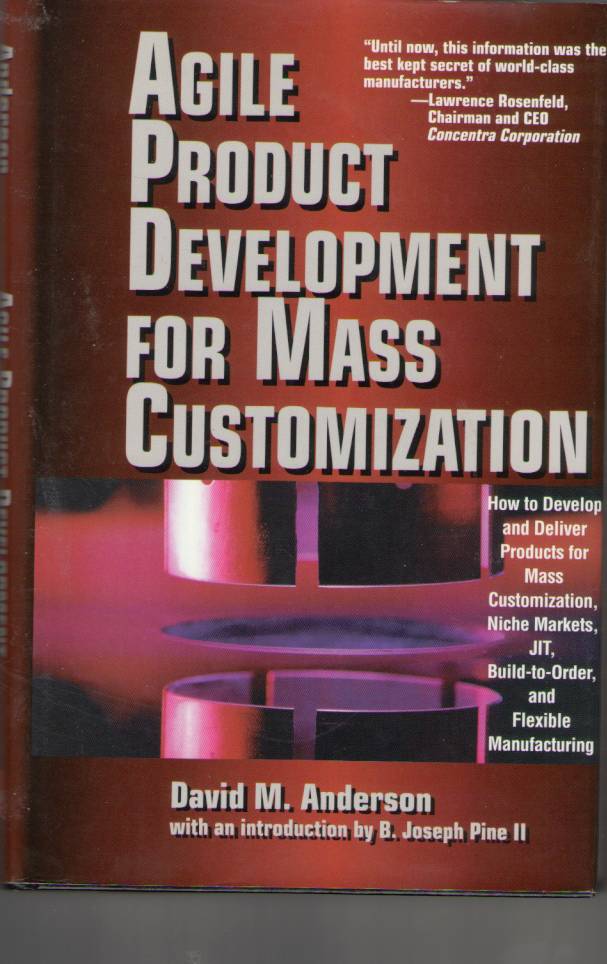
Dr. Anderson also wrote the first "how to" book on Mass Customization: "Agile Product Development for Mass Customization; How to Develop and Deliver Products for Mass Customization, Niche Markets, JIT, Build-to-Order, and Flexible Manufacturing," by David M. Anderson, with an introduction by B. Joseph Pine II, published by McGraw-Hill in 1996 is now out of print. The book has been printed in a Chinese translation (simplified character Mandarin) from McGraw-Hill's Singapore office: www.asia-mcgraw-hill.com.sg
Link to book description and used book order links at http://www.amazon.com .
THE QFD HANDBOOK
Dr. Anderson was asked to write a Chapter 6, "QFD and Designing for Manufacturability and Customization," in the QFD Handbook, by Jack B ReVelle, John W. Moran, and Charles A. Cox (1998, John Wile, 410 pages)
SME TOOL AND MANUFACTURING ENGINEERS HANDBOOK
The Society of Manufacturing Engineers asked Dr. Anderson to write the opening chapter, "Design for Manufacturability," for its Tool and Manufacturing Engineers Handbook, Volume VI, on Design for Manufacturability, (1992. Fourth Edition, SME)
INDUSTRIAL ROBOTICS HANDBOOK
In 1983 Dr. Anderson wrote an essay on “The Future of Robotics” in the
Industrial Robotics Handbook, by V. Daniel Hunt (1983, Industrial Press, 432
pages)
Design for Manufacturability: How to Use
Concurrent Engineering
to Rapidly Develop Low-Cost, High-Quality Products for Lean Production"
Second Edition;
Published by Productivity Press, 2020
(Sample TOC entries: Red and italic type below indicate unique or not puibhed anywhere else)
Section I Design Methodology
Chapter 1
Design for Manufacturability............................................ 3Not1.1 Manufacturing before DFM
1.1.1 What DFM is
hapter 2
Concurrent Engineering................................................... 372.1 Resources
2.2 Resource Availability, Ensuring
2.3 Portfolio Planning for Products
2.4 Parallel and Future Projects
2.5 Designing Products as a Team
2.6 Vendor/Partnerships
Chapter 3 Designing the Product.................................................... 115
3.8 Half-Cost Product Development3.1 Design Strategy
3.2 Thorough Up-Front Work, Importance of......
3.3 Architecture/System Design, How to Optimize.
3.4 Part Design Strategies.
3.5 Design for Everything (DFX).
3.6 Creative Product Developmen
3.7 Brainstorming
Section II Flexibility
Chapter 4
Designing for Lean & BTO............................................. 197
4.1 Lean Production
4.2 Build-to-Order
4.3 Mass Customization.
4.4 Developing Products for Lean, BTO&MC
4.5 Portfolio Planning for Lean, BTO&MC
4.6 Low-Volume/High-Mix, Designing fo 4.7 Platform Family Design & Manufacture
4.8 Scalability
4.9 Modular Design
4.10 Offshoring and Manufacturability.
4.11 Lean and BTO&MC Value
Chapter 5
Standardization............................................................... 2395.18 Off-the-Shelf Parts5.1 Part Proliferation
5.2 Part Proliferation Cost
5.3 Part Proliferation, Why it Happens
5.4 Part Proliferation Consequences
5.5 Part Standardization Strategy
5.6 Early Standardization Steps
5.7 Zero-Based Approach
5.8 Standard Part List Generation
5.9 Part Standardization Results
5.10 Raw Materials Standardization
5.11 Standardization of Expensive Parts
5.12 Consolidation of Inflexible Parts
5.13 Tool Standardization
5.14 Feature Standardization
5.15 Process Standardization.
5.16 Encouraging Standardization
5.17 Reusing Designs, Parts, and Modules
he book Table of Contents has 814 entries in four levels, two of which are shown in four sample chapters above.
The Index is fullly cross-indexed with 2511 entries, with unique or never-before-published topics in italics, as is also done in the Table of Contes. This is especiallly useful for people upgrading from the 2014 first edition.
[Home] [DFM Consulting] [DFM Seminars] [DFM Books] [Credentials] [Clients]
[DFM article] [Half Cost article] [Standardization article] [Mass Customization article] [BTO article] [Rationalization article]
Copyright © 2019 by David M. Anderson